
The quiet role of an end-of-life doula
I had the opportunity to present to my local hospice on the role of an end-of-life doula.
A doula is a non-medical professional who supports patients and caregivers emotionally, practically, and relationally. Many people are familiar with birth doulas. They help bring new life into the world with presence, calm, and care.
End-of-life doulas offer that same kind of presence, but at the end of life.
They help support a more peaceful exit from this world.
That distinction seemed to resonate. I could feel it in the room.
And then we moved to the question that matters just as much:
Given that hospice already provides compassionate and comprehensive care…
where does a doula fit?
In partnership, not in place
Before anything else, it’s important to say this clearly:
Hospice teams provide extraordinary care. I always recommend using hospice for end-of-life care. Quality of life matters right up to the very end. They are the experts in pain management and comfort care, allowing patients to live more fully until the end.
Nurses, social workers, chaplains, aides, volunteers, each brings deep expertise, compassion, and commitment to patients and families during one of life’s most tender times.
Doulas do not replace that care.
We do not duplicate it.
And we are not clinical providers.
Instead, we work alongside hospice teams, supporting and extending the care that is already in place.
The spaces between visits
Even with excellent care, there are natural rhythms to hospice support.
Visits happen. Care plans are followed. Needs are addressed.
And in between those visits, life continues.
A caregiver may have a question that surfaces later.
A patient’s mood or energy may shift.
A quiet moment may open where something important wants to be said.
These are not gaps in care.
They are simply part of being human.
And they are often where doulas can be most helpful.
Observational support, with humility
Because doulas are non-medical and often have a smaller number of clients, we are sometimes able to be present more frequently or for longer periods of time.
That presence allows us to notice things.
Not in a clinical or diagnostic way.
But in a human, attentive way.
We might notice a subtle change in comfort, energy, or mood.
We might sense that a caregiver is becoming overwhelmed.
We might hear a concern that hasn’t yet been shared with the care team.
Our role is not to interpret or diagnose those changes.
It is to extend the eyes and ears of the care team, sharing observations when appropriate and helping ensure that concerns are communicated.
In that way, we become part of the larger circle of support.
Time, presence, and continuity
One of the most meaningful ways doulas complement hospice care is through time.
We can often sit a little longer.
We can return more frequently.
We can offer a kind of continuity that helps patients and families feel steadier.
This doesn’t replace the work of hospice.
It reinforces it.
It gives patients and caregivers another layer of support, especially in the emotional and relational aspects of care.
What “holding space” looks like in real life
“Holding space” is a phrase that can feel abstract, but in practice, it’s very simple.
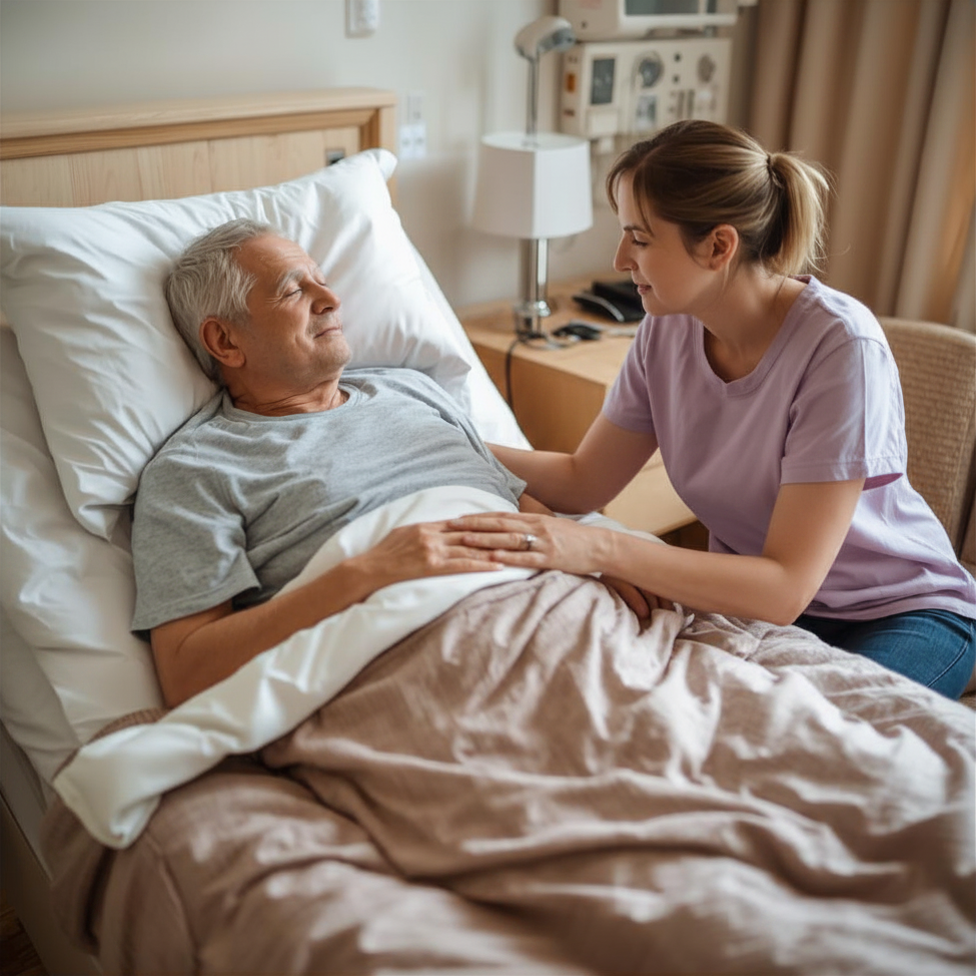
It looks like sitting at the bedside so someone is not alone.
It looks like listening without needing to fix anything.
It looks like helping a family find the words for a difficult conversation.
It looks like gently encouraging a caregiver to take a breath, or a break.
It looks like being present in the moments that don’t always have a clinical task attached to them.
A personal reflection on presence
This work is deeply personal to me.
When my husband, John, was dying, we had the gift of conversations ahead of time. We had talked about his wishes, his values, and what quality of life looked like to him.
Because of that, when decisions needed to be made, I felt a sense of clarity. Even in the midst of grief, I knew I was honoring him. I wasn’t guessing. I wasn’t wondering if I was getting it right.
That didn’t make it easy.
But it made it steadier.
When my mom died, the experience was very different. Her death came as a medical event, and we hadn’t had those same conversations.
I found myself in those in-between moments. I was trying to make sense of what she would have wanted, carrying the weight of uncertainty.
That gap stayed with me.
Not as regret, but as a realization.
How much those quiet moments matter.
How much support is needed in the spaces where decisions, emotions, and meaning all intersect.
It’s one of the reasons I feel so strongly about this work.
Supporting the whole circle of care
End-of-life care is never just about one person.
It includes everyone who loves them.
Hospice teams already recognize and support this beautifully, and doulas can help extend that support in more informal, flexible ways.
We might help someone think through how they want to be remembered.
We might sit with a caregiver after a long day.
We might help create a small ritual or moment of meaning.
We are not there to lead.
We are there to walk alongside both the family and the care team.
Why this partnership matters
At the end of life, so much of what matters cannot be measured.
It’s found in presence.
In conversation.
In quiet moments of connection.
Hospice teams make those moments possible through expert care.
Doulas help tend to them, gently and consistently, in the spaces in between.
Together, this creates a more complete circle of support, one that honors not just the medical needs of a person, but their human experience as well.
A gentle invitation
If you are part of a hospice team, thank you. The work you do matters deeply.
If you are a caregiver or family member, you don’t have to navigate those in-between moments alone.
And if you are simply someone thinking ahead, consider this:
What would it feel like to have support not just for the care itself,
but for the moments in between?
Those moments matter.
And they deserve care, too.