Every October, the world turns pink.
Pink ribbons appear on everything from T-shirts to coffee cups. Survivors share their stories. Organizations raise money for research. Friends remind friends to schedule their mammograms.
For some people, Breast Cancer Awareness Month is empowering. For others, it can feel overwhelming, commercialized or far too tidy for something as complicated as cancer.
I’ve come to believe there’s room for all of those reactions.
Because every cancer story is different.
The Cancer Story I Didn’t Know
My mum was a breast cancer survivor.
For the first ten years, my sister and I didn’t know that.
She went through diagnosis and treatment without telling us. She continued coming to family events. We saw her. We talked to her. Somehow, we never realized what she was going through.
When she finally told us, after my stepfather died, we were stunned.
My sister and I found ourselves doing calculations. What was happening in our lives ten years earlier? When had she been in treatment? How had we missed it?
After going through my husband John’s cancer journey and seeing what treatment could do to his energy, I wondered whether we had simply seen Mum on her best days.
I also thought about all those years when I had gone for my own annual mammogram and confidently answered the question about family history.
No. No family history of breast cancer.
Except there was.
I don’t know exactly why Mum kept her diagnosis from us. She was an intensely private person, and I suspect part of it was not wanting us to worry. But I can’t know that for certain.
I also don’t know exactly why she chose to tell us when she did. It was after losing her husband, and sometimes I’ve wondered whether being confronted with his mortality, and perhaps her own, made that secret feel heavier.
But that is her story, and she isn’t here for me to ask.
Then Something Changed
What I do know is that after she told us, something changed.
Mum began talking about being a breast cancer survivor. She wore breast cancer awareness T-shirts. She wore one to her annual scans.
The woman who had once kept her cancer so private that her own daughters didn’t know about it began publicly embracing her survivorship.
Maybe there was relief in no longer carrying the secret. Maybe her relationship with cancer had simply changed over those ten years. I don’t know.
What I understand better now is how much a cancer diagnosis can ask of a person.
At diagnosis, sometimes the only thing you can do is concentrate on the next appointment, the next treatment, the next decision.
Then treatment ends, or doesn’t, and another kind of living begins.
Many cancer survivors talk about “scanxiety”: the anxiety that comes with follow-up scans and the possibility that cancer has returned. A scan that looks routine on someone’s calendar can carry an enormous emotional weight.
And survivorship itself doesn’t look the same for everyone.
Some people reach NED, meaning no evidence of disease. They get to ring a bell at the end of treatment.
Others continue treatment indefinitely. They move from one therapy to another, or from one clinical trial to the next. There may never be a moment when someone says, “You’re finished.”
Survivorship doesn’t always come wrapped in a neat pink bow.
When Pink Means Something and When It Doesn’t
I have a friend who is a breast cancer survivor who talks about “pink-washing.”
Her concern isn’t with research or advocacy. It’s with companies that turn a product pink in October, raise the price, and benefit from Breast Cancer Awareness Month without making a meaningful contribution to breast cancer research, services, or advocacy.
That’s an important distinction.
If we’re going to spend money in the name of breast cancer awareness, it’s reasonable to ask where that money goes.
At the same time, I have many friends in the cancer community who embrace October as an opportunity to make a real difference.
They raise money for research.
They encourage people to get their mammograms.
They volunteer with organizations supporting people impacted by cancer.
They remind people to know what is normal for their own bodies and to pay attention when something changes.
They tell their stories.
Just as survivorship takes many forms, so does advocacy.
There Is No Right Way to Do October
Maybe that’s what I wish we talked about more during Breast Cancer Awareness Month.
There is no correct way to have cancer.
There is no correct way to be a survivor.
And there is no obligation to turn your cancer experience into advocacy.
If wearing pink and telling your story gives meaning to your experience, wear the shirt. It can be healing and impactful.
If raising money for research gives you purpose, raise it. Cancer research desperately needs funding.
If you want to remind every person you know to schedule a mammogram, remind them. We all need that type of friend.
If you want to ask hard questions about where all that October fundraising money actually goes, ask them. You can even help businesses set up a fundraiser to go to an organization you find impactful.
And if you don’t want to do any of those things, that’s okay, too.
Cancer is hard enough.
I do believe in having a circle. Cancer is a tremendous thing to carry completely alone. But that circle doesn’t have to be public. It can be family, friends, a support group, other survivors or just a few people you trust.
You get to decide how wide that circle becomes.
Every Story Is Different
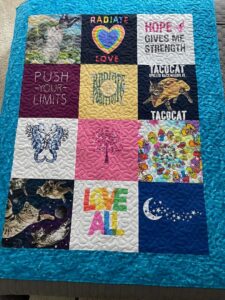
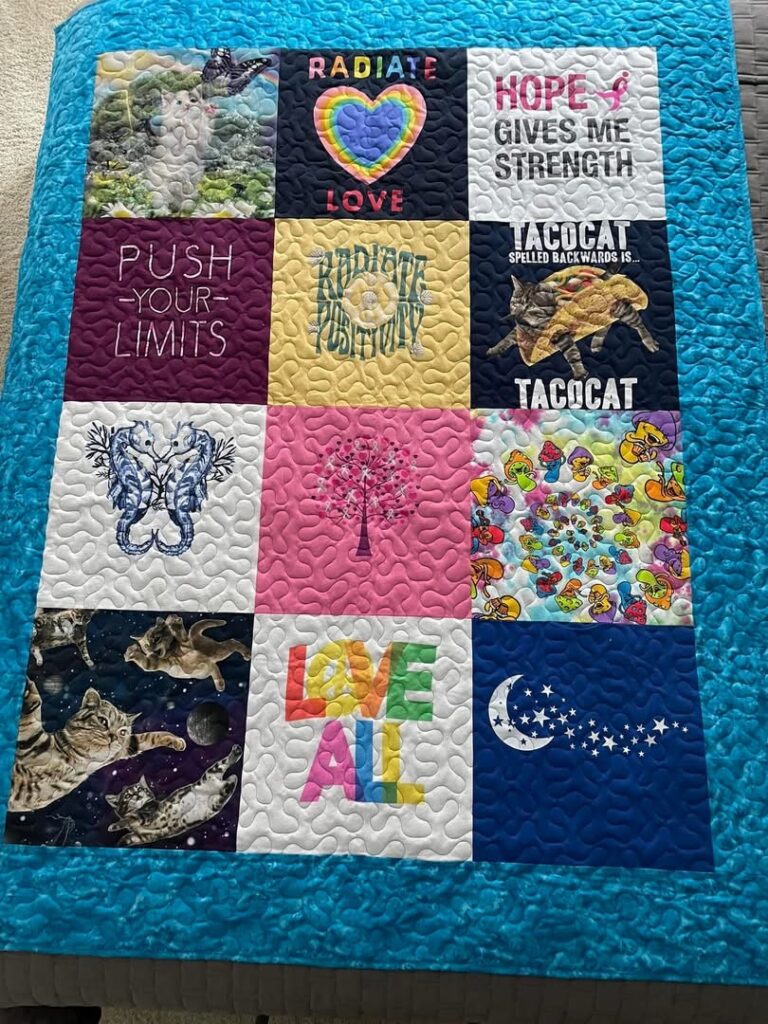
After Mum died, I had some of her T-shirts made into quilts, one for my sister and one for me.
In the center of each quilt is one of the breast cancer awareness shirts Mum wore to her annual scans.
I love the symbolism of that now.
For ten years, her breast cancer story was something she held very close.
Later, she chose to wear it across her chest.
Both were part of her survivorship.
Both belonged to her.
So when everything turns pink this October, perhaps awareness can mean something bigger than a ribbon.
We can support research. We can encourage screening. We can volunteer. We can donate. We can share our stories to influence others. We can ask companies whether their pink products are actually supporting the cause they invoke.
But we can also make room for the person who doesn’t want to wear pink.
We can recognize the person who is NED and the person heading to another treatment.
We can celebrate the person who tells their story to thousands and respect the person who tells only three people.
Because there isn’t one breast cancer story.
There are millions of them.
And each person gets to decide how their story is told.