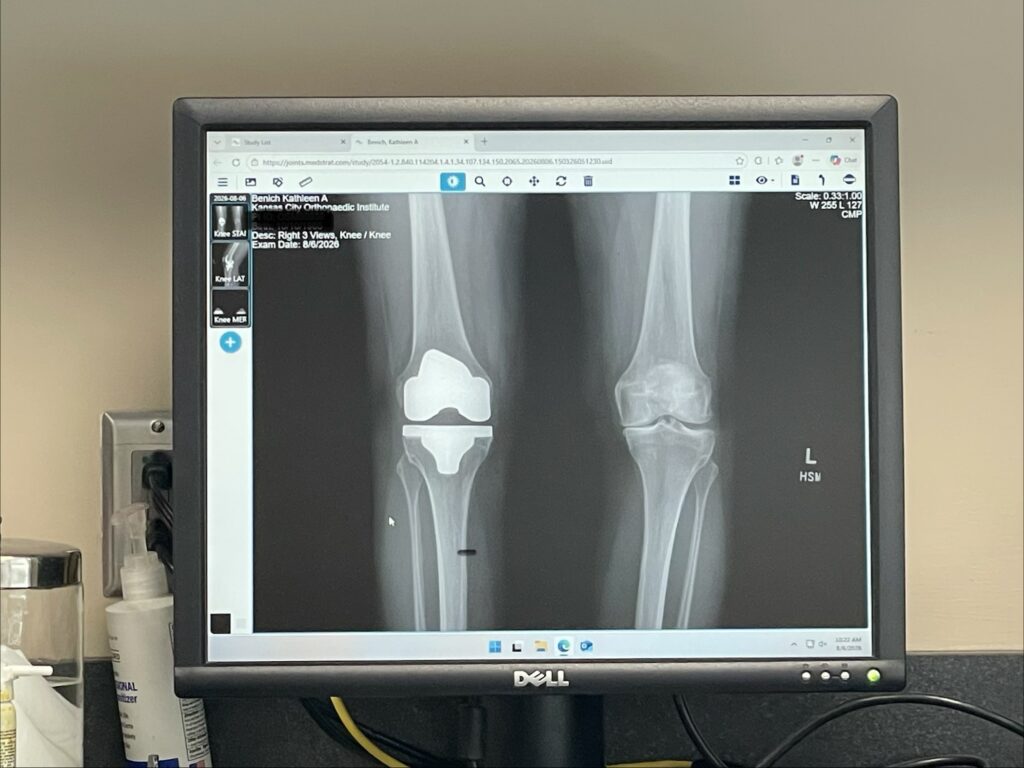
When I walked into the exam room for my six-week follow-up after knee replacement surgery, my x-ray was already displayed on the monitor.
The surgeon wasn’t in the room yet.
I was surprised, and pleased, to see it there. It gave me a few private minutes to study it on my own and process what I was seeing.
I wasn’t looking at the implant. In fact, that wasn’t what caught my attention at all.
I was looking at the line of my leg.
For years, osteoarthritis had slowly caused my knees to bow. I’d seen x-rays before, but I hadn’t fully appreciated just how much the alignment had changed until I was looking at this one. My repaired leg was straight. Next to it, I could see the slight bow that remains in the other leg.
I found myself smiling.
When my surgeon came into the room, I was the one who pointed it out.
Recovery hasn’t always given me such obvious evidence of progress. There are still strengthening exercises ahead. My endurance isn’t back yet. Fatigue has been one of my biggest frustrations, although my surgeon explained that surgery can cause anemia for up to three months. Since I already have anemia, my increased fatigue made a lot of sense.
But there have been other signs that things are changing.
After surgery, I learned to climb stairs one step at a time, always leading with my “good” leg going up and my surgical leg coming down. I jokingly called it “walking like a toddler.” Every step up started with my left leg. Every step down started with my right.
This week, I’ve been able to alternate my legs and take the stairs in a normal cadence again.
Right. Left. Right. Left.
It doesn’t sound particularly exciting until you’ve spent weeks unable to do it.
That small milestone also gave me something else: reassurance. My other knee is scheduled for replacement in December. Knowing that this knee can once again carry me up and down the stairs normally makes the thought of doing this all over again a little less daunting.
Seeing my leg straight on the x-ray and feeling my body move differently on the stairs reminded me of something much bigger than orthopedic surgery.
We adapt to difficult circumstances so gradually that we don’t always realize we’re adapting.
I thought about this after my own surgery, when suddenly I was the one thinking about how far I would have to walk, whether there would be stairs, and how difficult it might be to get from the car to wherever I was going.
I’d done all of that before.
When John was ill, I wanted him to be able to save his limited energy for the things that mattered, like visiting with friends and family rather than using it all just getting there. So when we went out, I mentally reviewed what I knew about the destination. How far would we have to walk? Were there handicapped parking spaces nearby? What was the entrance like? Were there stairs? And we often brought the wheelchair as a backup in case getting from the car to our destination was simply too much.
I didn’t wake up one morning and decide this was my new routine. I learned it gradually, usually because we’d encountered a problem somewhere and I wanted to be better prepared the next time.
Eventually, all that planning simply became part of going out.
I’d actually forgotten how much mental preparation went into those outings until my own knee surgery put me temporarily on the other side of the equation. Once again, I found myself evaluating distances, stairs, parking and entrances before I went somewhere.
It reminded me how easily we adjust our lives around circumstances that change slowly. We compensate. We develop new habits. We learn what to anticipate. Eventually, we stop thinking of any of it as adapting.
It simply becomes how we move through the world.
My knees did the same thing. As the osteoarthritis progressed, my gait changed little by little. My body compensated until the unusual felt completely normal.
And now, recovery is asking my body to learn something new again.
Maybe that’s one of the quieter lessons of healing. We tend to look for the big milestones, such as the surgery, the clean scan, the last treatment, the day we return to work. But sometimes the most meaningful evidence of change is much smaller.
It’s taking the stairs right-left-right-left without thinking about it.
It’s realizing you no longer need to calculate every step before leaving the house.
It’s noticing that something you once had to work around isn’t demanding quite so much of your attention anymore.
Healing isn’t always a return to exactly who or where we were before. Sometimes it’s discovering that we have adapted again, this time toward something better.
When I walked into that exam room, I wasn’t expecting an x-ray to make me smile.
But for a few quiet minutes before my surgeon came in, I had the chance to look at where I’d been and where I am now.
I wasn’t just seeing metal, bone, and surgical precision.
I was seeing alignment.
And sometimes that’s exactly what healing looks like.