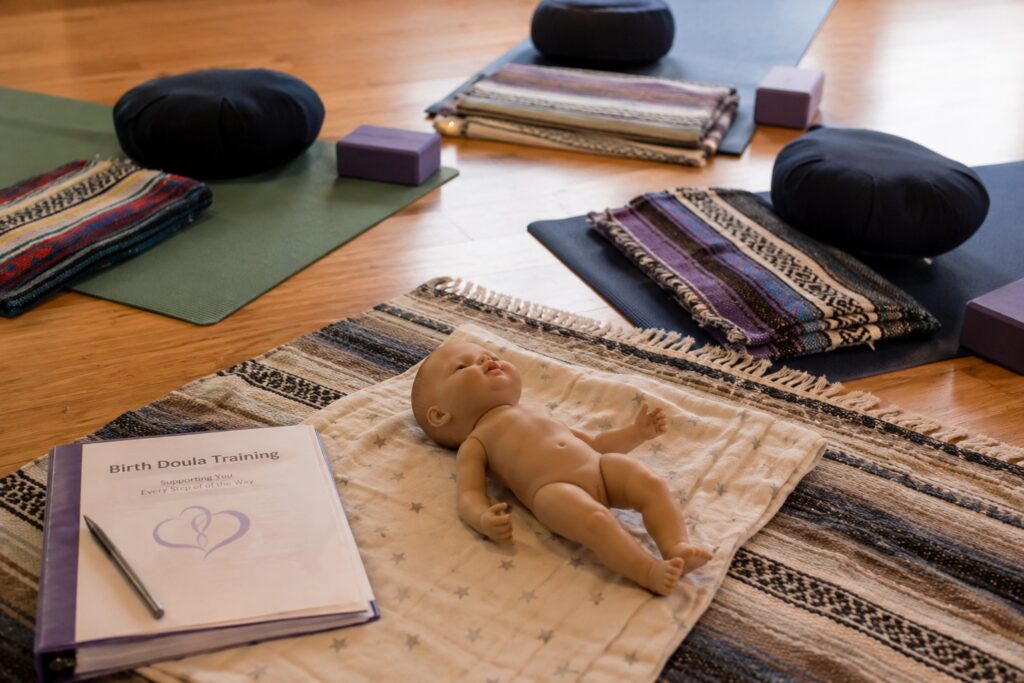
Last weekend, I spent three days learning how to help bring babies into the world.
By the end of it, I was quite certain I’d rather help people leave it.
I took a birth doula class partly out of curiosity. As an end-of-life doula, I’ve often heard the term full-spectrum doula used to describe someone whose work encompasses support at both the beginning and the end of life. I wondered whether that might be something I wanted to explore.
I learned enough over those three days to know that it isn’t.
I am much more comfortable supporting people at the end of life than I would be supporting someone through childbirth. But I also came away from the class with something I hadn’t necessarily expected: a greater appreciation for birth doulas and the work they do. I would absolutely recommend considering one.
And I was struck by just how much the two kinds of doula work have in common.
The Same Foundation, Very Different Moments
Whether someone is entering the world or preparing to leave it, a doula provides non-medical support. That can include emotional, practical, informational and spiritual support, not only for the person at the center of the experience, but also for the people who love and support them.
The overall definition is remarkably similar.
The specifics, of course, are very different.
But as I sat in class learning about birth, I kept finding myself thinking about death.
No two experiences are the same
At one point, our instructor said that she learns something new at every birth. No matter how many she attends, each one is different and each one teaches her something.
I immediately understood what she meant.
Birth and death are among our most personal human experiences. There may be common physical processes and patterns. There may be things that doulas, nurses and other professionals recognize because they have seen them many times before.
But there isn’t a script.
Every person is different. Every family is different. Every experience unfolds in its own way.
Perhaps part of being a good doula at either end of life is knowing a great deal while still being willing to enter each experience without assuming you know exactly how it will go.
Plans matter, even when they change.
Birth plans get talked about quite a bit. In my work, I spend much more time thinking about end-of-life wishes and plans.
In both cases, the plan has value even though no one can guarantee that events will unfold according to it.
Things change. Complications happen. Bodies don’t always follow our timelines. New information can require new decisions.
That doesn’t make planning pointless.
Thinking through possibilities in advance allows people to consider what matters to them when they aren’t in the middle of an intense moment. What do I want? What am I worried about? What would make me more comfortable? If my first choice isn’t possible, what would I prefer instead?
You may eventually have to take a different path. But it is much easier to navigate that path when you’ve already had some of the conversations.
The body knows what to do.
In end-of-life work, we often talk about the body knowing how to die.
That can sound strange until you understand what it means. As death approaches, the body begins an organized process of shutting down. Appetite changes. Sleep changes. Breathing changes. Systems that are no longer necessary begin to slow.
Learning what is happening can make something frightening feel a little less frightening.
During my birth doula class, I kept hearing a familiar message: the body knows how to give birth, too. There are changes that occur before labor and processes that unfold as the body prepares to bring a baby into the world.
Obviously, medical intervention can be necessary at either end of life. Bodies don’t always do what we expect them to do.
But there was something fascinating to me about recognizing that at both the beginning and the end of life, the human body has processes designed to carry us through the transition.
Birth and death have both become medical events.
This was perhaps the similarity that made me think the most.
Modern medicine has made childbirth safer. It can relieve suffering at the end of life. Medical professionals and interventions can be essential during both experiences.
I’m certainly not suggesting that we should remove medicine from either one.
But birth and death are not only medical events.
They are human experiences.
When either becomes primarily about procedures, monitors, medications, and protocols, it can become easier to lose sight of the person at the center.
What matters to them? What makes them feel safe? Who do they want nearby? What are they afraid of? What do they hope this experience will look like?
Medical needs sometimes require plans to change. But when there isn’t a medical reason to abandon someone’s wishes, those wishes deserve to remain part of the conversation.
Someone needs to keep the person at the center
This may be where the role of a doula becomes especially important.
A doula isn’t there to replace doctors, nurses, midwives, hospice professionals or anyone else on the medical team. Nor is a doula there to make decisions for someone.
A doula can help a person understand their options, think through what matters to them, prepare questions and communicate their wishes. They can also help the people supporting that person understand what is happening and how they can help.
Sometimes, in a complicated system, simply having someone continually return to the question What does this person want? can be incredibly valuable.
I Don’t Need to Cover the Whole Spectrum
After three days of learning about birth doula work, I don’t think I’ll be adding it to my résumé.
And that’s okay.
If anything, the experience made me more certain about where I belong. I feel comfortable at the end of life. I am comfortable talking about dying. I’m comfortable helping people and families navigate the uncertainty, emotions and decisions that come with it.
Birth doulas have a different set of knowledge and skills, and after getting a glimpse into their work, I have tremendous respect for what they do.
Maybe I don’t need to be a full-spectrum doula to appreciate the full spectrum.
At both ends of life, there are medical professionals whose job is to watch vital signs, administer medications, perform procedures and respond when something goes wrong.
And we need them.
But there is also value in having someone whose primary focus is different.
Someone who listens.
Someone who explains.
Someone who helps you prepare for what might come next.
Someone who reminds everyone in the room that, in the middle of all the medical care, there is a human being experiencing one of life’s most profound transitions.
The beginning and the end may be very different places.
But perhaps the need to feel heard, supported and cared for isn’t so different after all.