September is Ovarian Cancer Awareness Month, which always makes me think about Gilda Radner.
Most people know Gilda as one of the original cast members of Saturday Night Live. She was funny, fearless, and unforgettable. She died of ovarian cancer in 1989 at just 42 years old. Her experience with cancer helped inspire what would become Gilda’s Club, a place where people impacted by cancer could find support, connection, and community.
My own relationship with Gilda’s Club Kansas City began in a way I never could have predicted.
During my husband John’s cancer treatment, I had seen flyers for Gilda’s Club. I knew support was available there, but at the time, I simply couldn’t imagine adding one more thing to my life.
Caregiving was already a full-time job layered on top of everything else. There were appointments, medications, treatments, decisions, logistics, work, and the constant mental work of figuring out what came next.
A support group might have been helpful.
I just didn’t feel like I had time to go.
After John died, I found myself dealing with some of the physical remnants of caregiving. We had durable medical equipment that we no longer needed, and I wanted it to go to someone who could use it.
I contacted Gilda’s Club.
They didn’t accept medical equipment themselves, but they knew a community organization that did. I drove over with the items I wanted to donate.
And during that visit, a woman at Gilda’s Club said something simple to me.
She told me they had a Living With Loss support group. She gave me the contact information and said I could call when I was ready.
I had walked through the door trying to give something away.
I had no idea how much I would eventually receive.
The Relief of Hearing, “Me Too”
I joined the Living With Loss group, and one of the most helpful things about it was discovering how much of what I was experiencing was simply part of grief.
When you are grieving, it is easy to assume that every difficult interaction is somehow about you.
Maybe you are doing grief wrong.
Maybe people are avoiding you because you make them uncomfortable.
Maybe you are too emotional.
Maybe you should be “doing better” by now.
Then you sit in a room with other people who have experienced loss, and someone tells a story that sounds so similar to yours.
One example we talked about was how friendships can change after the death of a spouse or partner.
Some couples stop calling.
Invitations become less frequent.
At first, that can feel deeply personal.
But as we talked about it together, we began to see that often it wasn’t about us at all.
It was about who was no longer in the room.
Our loss was uncomfortable for people. Sometimes it reminded couples of something they didn’t want to imagine: One of us could die, too.
Understanding that didn’t necessarily make the losses of those friendships hurt less. But it helped us stop interpreting every change as a judgment about ourselves.
The same was true of things people said.
“He’s in a better place.”
“At least you have your memories.”
“She wouldn’t want you to be so sad.”
I don’t think most people say things like that because they intend to hurt someone. Often, they simply don’t know what to say.
But those words can still feel as though they are minimizing grief or asking someone to move past feelings that need to be felt.
Hearing other people in the group say, “Someone said that to me, too,” helped.
It normalized the experience.
It reminded us that sometimes the awkward or painful things people say are less about our grief and more about their discomfort with grief.
And perhaps most importantly, the people in that room simply got it.
There are some experiences you can explain perfectly and still not fully communicate to someone who hasn’t lived them.
When people have experienced a significant loss themselves, you don’t have to explain quite as much.
They understand why an ordinary Tuesday might suddenly be hard.
They understand why you can be laughing one moment and crying the next.
They understand that grief doesn’t move in a straight line.
They get it.
Community That Lasted
The support group ended, but the relationships did not.
I still keep in touch with people from that group.
In fact, just last week I was walking in Loose Park when I unexpectedly ran into two of the women who had been in the group with me.
We stopped and talked.
And almost immediately, it felt like old times.
We picked up right where we had left off.
That moment reminded me that Gilda’s Club had given me more than a support group.
It had given me community.
From Support Group to Boardroom
A couple of years later, I was taking classes toward a master’s degree in public health. In one leadership class, we were asked to give a presentation about our dream career.
Most of the students were much younger than I was and were just beginning their careers.
I remember thinking, My dream career? I’m in the sunset of mine.
The assignment didn’t seem to fit where I was in life.
I mentioned that to my advisor and then realized something.
If I could choose what I genuinely wanted to do next, I wanted to serve on the board of Gilda’s Club.
This was an organization that had helped me when I needed it. It was also helping countless other people impacted by cancer.
Not long after that assignment, I was at Starlight Theatre for a Lyle Lovett concert.
I noticed the executive director of Gilda’s Club sitting in the next section.
I decided this was my chance.
At intermission, I walked over and told her that serving on the Gilda’s Club board was something I hoped to do.
She was receptive.
“Let’s get coffee,” she said.
And somehow, from there, everything began to fall into place.
Listening to What People Actually Need
One thing I have particularly appreciated during my years with Gilda’s Club is the organization’s willingness to listen and evolve.
Cancer affects far more than the body.
It affects relationships, careers, finances, families, identity, mental health, and a person’s sense of what the future might look like.
And the needs of people living with cancer are not always defined by the type of cancer they have.
For example, we heard from younger survivors who didn’t always feel that traditional cancer-specific support groups addressed the issues they were facing.
They might be worrying about fertility and whether they should freeze their eggs.
They might have young children at home and be struggling with childcare.
They might be trying to navigate dating, career decisions, or questions about starting a family.
Those issues crossed cancer types.
Sometimes what connected people wasn’t their diagnosis.
It was their stage of life.
That is one of the things I value about Gilda’s Club: a continuing effort to understand what people actually need and create community around those needs.
I also deeply value its focus on mental and emotional well-being.
Medical teams quite appropriately concentrate on treating the disease.
But cancer happens to a whole person and often to an entire family.
People need places where the emotional and social pieces of cancer are acknowledged too.
Coming Full Circle
Last year, I chaired Gilda’s Club Kansas City’s auction. This year, I’m serving on the committee again.
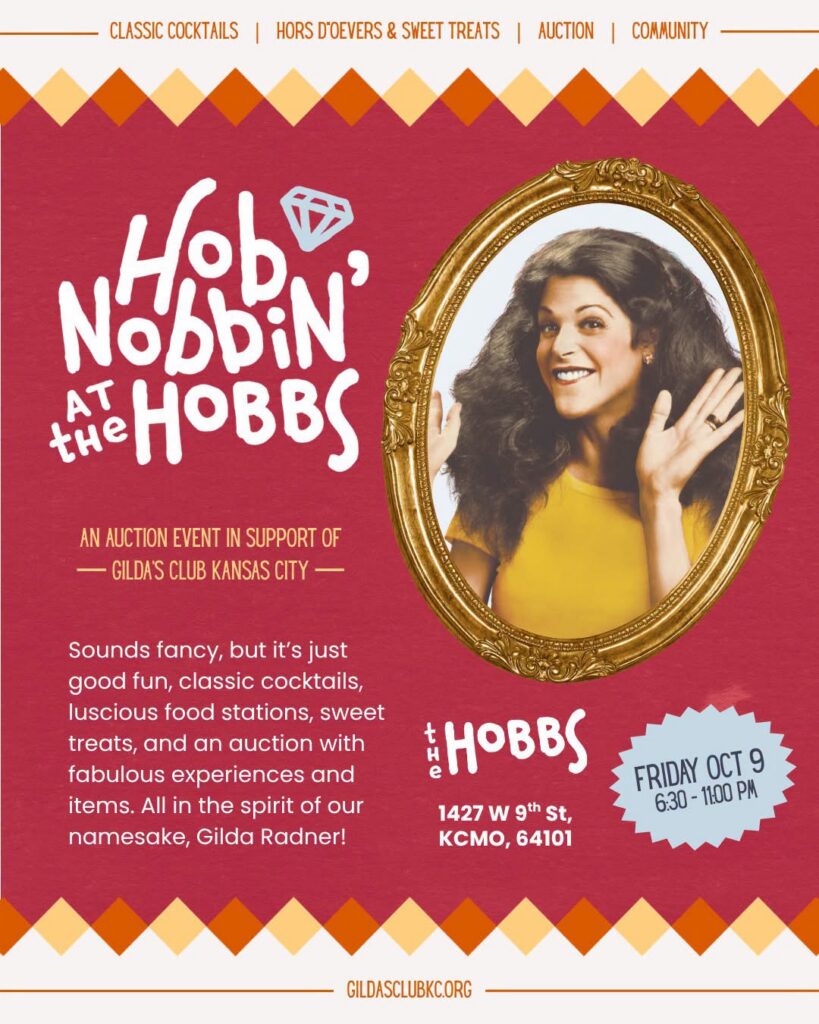
On October 9, we’ll gather for Hobnobbin’ at the Hobbs, an evening of food, cocktails, community, and an auction benefiting Gilda’s Club Kansas City.
Fundraisers are fun.
But for me, this one has never been just about putting on a good event.
I know what those dollars make possible because I have sat on the other side of the equation.
I know what it means to walk into Gilda’s Club carrying something heavy.
I know what it means to sit with people who understand without requiring an explanation.
I know what it means to discover that something you thought was uniquely wrong with you is, in fact, something other grieving people have experienced too.
And I know what it means for someone to say, “We have something that might help. Call us when you’re ready.”
When I first walked into Gilda’s Club looking for somewhere to donate medical equipment, I had no idea how much that organization would eventually give back to me.
It became part of my healing.
It became part of my community.
And, at a time in my life when I was beginning to ask what came next, it became part of my sense of meaning and purpose.
That is quite a legacy for the woman whose name is on the door.