
When people think about caregiving, they often focus on the intensity of the illness itself including, the appointments, medications, sleepless nights, uncertainty, and emotional exhaustion. What we talk about far less is what happens when the caregiving ends.
I remember waking up after John died and realizing there was no one who needed me that day. No medications to organize. No appointments to manage. No one checking whether I had gotten out of bed. After years of caregiving, the silence felt enormous.
Before caregiving, I had always been a very heavy sleeper. There would be mornings when John mentioned a thunderstorm during the night and I had no idea one had even happened. But during his illness, something changed in me. I heard every shift in breathing and every movement. I would immediately ask if he was okay.
When caregiving ended, that hyper-vigilance didn’t simply turn off. My body and mind stayed in “high alert” mode for quite a while afterward. I think many caregivers experience this. We become so accustomed to monitoring, responding, anticipating, and protecting that our nervous systems forget how to rest.
At the same time, there is often a profound loss of purpose and identity that people don’t expect.
Caregiving can quietly become the structure around which life revolves. It shapes your routines, your priorities, your relationships, your thoughts, and even your sense of self. When it suddenly stops, the emptiness can feel disorienting.
And then there is the loneliness.
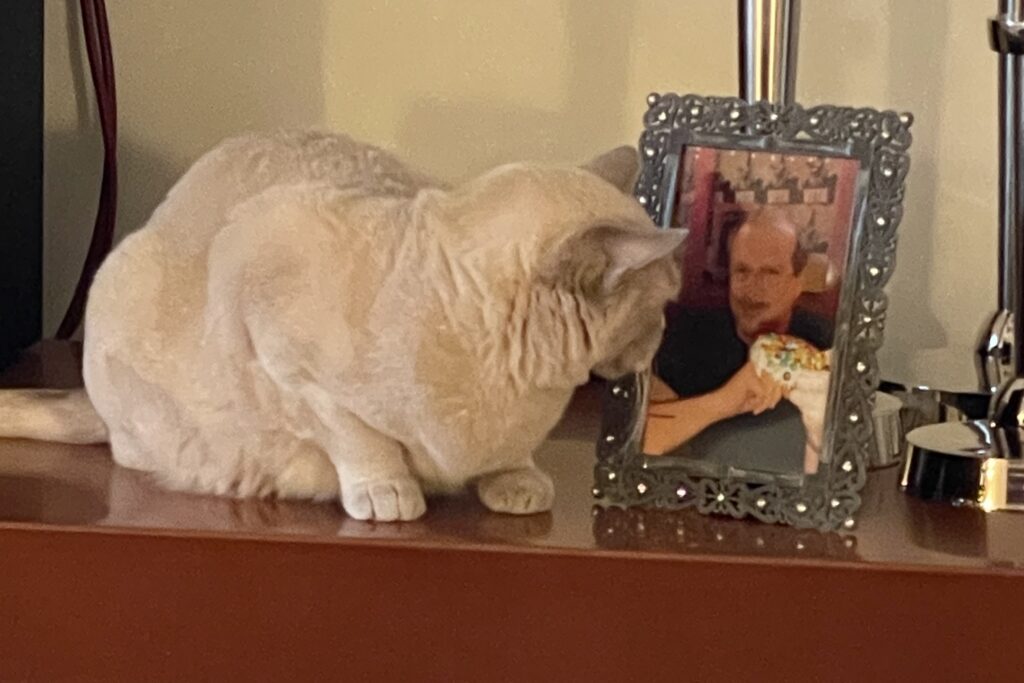
For me, the silence in the house after John died was especially difficult because it coincided with the beginning of the pandemic. The world already felt isolated, and grief amplified that feeling. At one point, the local animal shelter started a foster-at-home program, and I signed up to foster a cat. I realized I simply needed another heartbeat in the house. That small presence made things feel a little less lonely.
There were also moments when the reality of being alone hit me in practical ways.
One day, I experienced severe vertigo while walking home. I slowly made my way back by holding onto things along the route. When I finally got inside and turned to bolt the door, something I had done automatically for years, I suddenly realized I was alone in what could have become an emergency situation. There was no one there to notice if something was wrong. No one to help.
These moments are difficult to explain to people who have not lived through a deep caregiving experience and loss. There is grief, of course. But there is also disorientation. Numbness. Sometimes even resentment as the world seems to continue normally for everyone else while your own life has been completely altered.
And there can also be guilt.
In grief groups, I’ve heard many caregivers quietly admit feelings they were afraid to say out loud. Relief after a long illness. Exhaustion. The complicated emotions that come from loving someone deeply while also living through years of stress, fear, and caregiving responsibility.
Those feelings do not mean someone loved less.
They mean they are human.
One of the hardest parts of healing is realizing that caregiving and grief change us. We often cannot return to exactly who we were before. The experience reshapes our perspective on life, relationships, priorities, and time itself.
For me, rebuilding wasn’t about returning to my old identity. It was about slowly discovering what mattered now.
The turning point came when I learned about PIVOT (Patient and Investigator Voices Organizing Together) at the University of Kansas Cancer Center. The organization brings patient and caregiver perspectives into cancer research so scientists better understand what patients and families are truly experiencing and what matters most to them in terms of quality of life.
Their research philosophy is simple and powerful: “Nothing about us, without us.”
For the first time, I saw a way to use my caregiving experience to improve things for future patients and caregivers. Throughout my corporate career, I had focused on improving the employee experience through process improvement work. PIVOT felt like a natural continuation of that purpose, but in a much more personal way. Instead of improving systems for employees, I was now helping advocate for patients and caregivers navigating some of life’s hardest moments.
That work helped me begin rebuilding not the same life, but a meaningful new one.
I think that’s important for caregivers to hear.
Healing after caregiving does not necessarily mean “moving on.” It may mean carrying your experience forward differently. It may mean discovering new purpose, deeper compassion, stronger boundaries, or a renewed urgency to spend your time in ways that matter.
The experience of caregiving and deep grief changes us. It’s hard for it not to.
But slowly, over time, many caregivers begin to realize that while caregiving ended, the love behind it did not.
And perhaps that love can still shape what comes next.